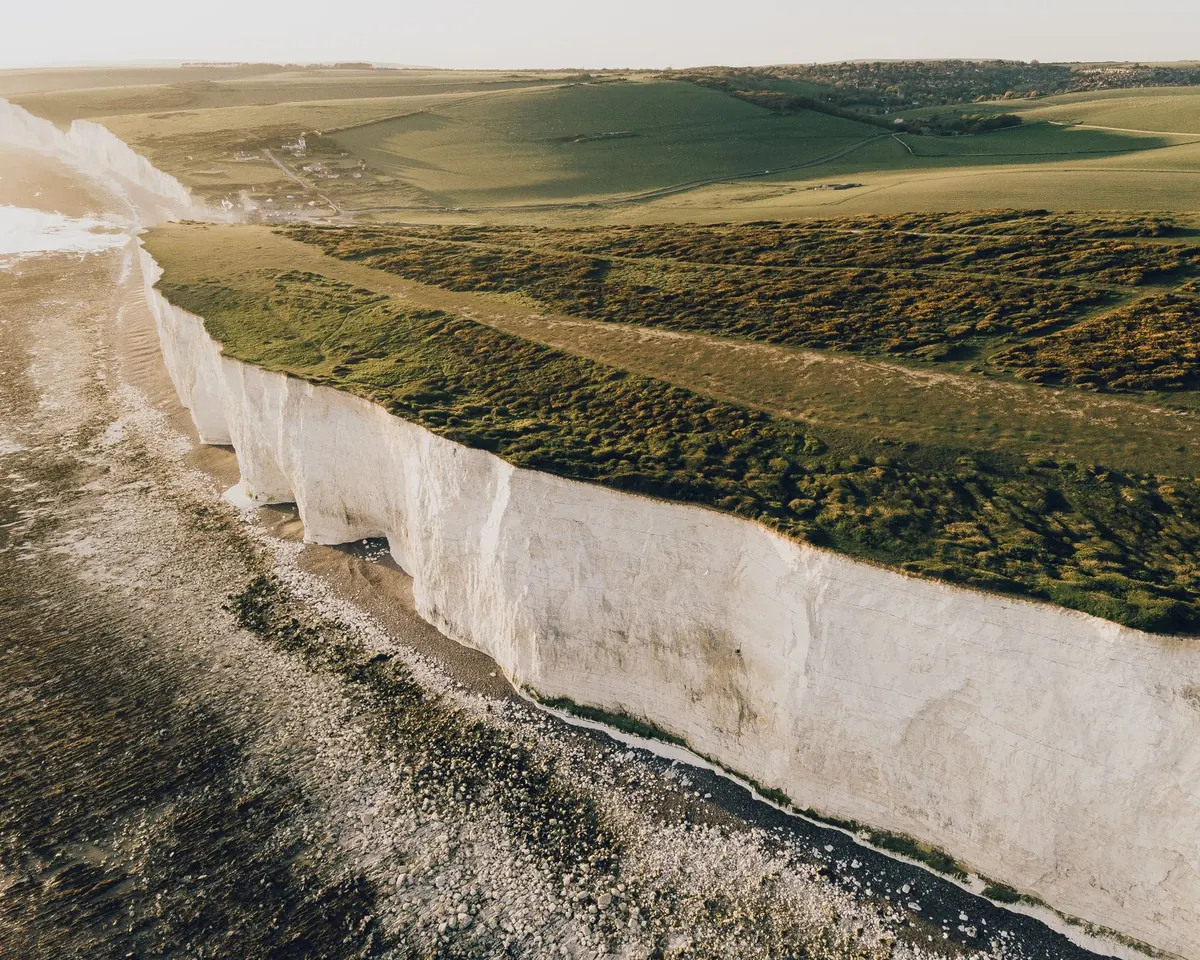
Cliffs look like the most solid thing on the coast. They are also the least permanent. Every metre of a cliff face is rock that has not yet fallen, and the sea is patient. Why cliffs crumble comes down to three processes working together: waves removing support at the base, weather weakening the rock itself, and gravity finishing the job. None of it needs to be dramatic. A cliff can retreat a little every winter and nobody notices until a fence post is left hanging over the edge.
Waves do less damage by brute force than you might expect. A wave striking hard rock largely bounces off. The harm happens because rock is not smooth, and because water forced into a gap is not gentle.
Four processes do most of the work:
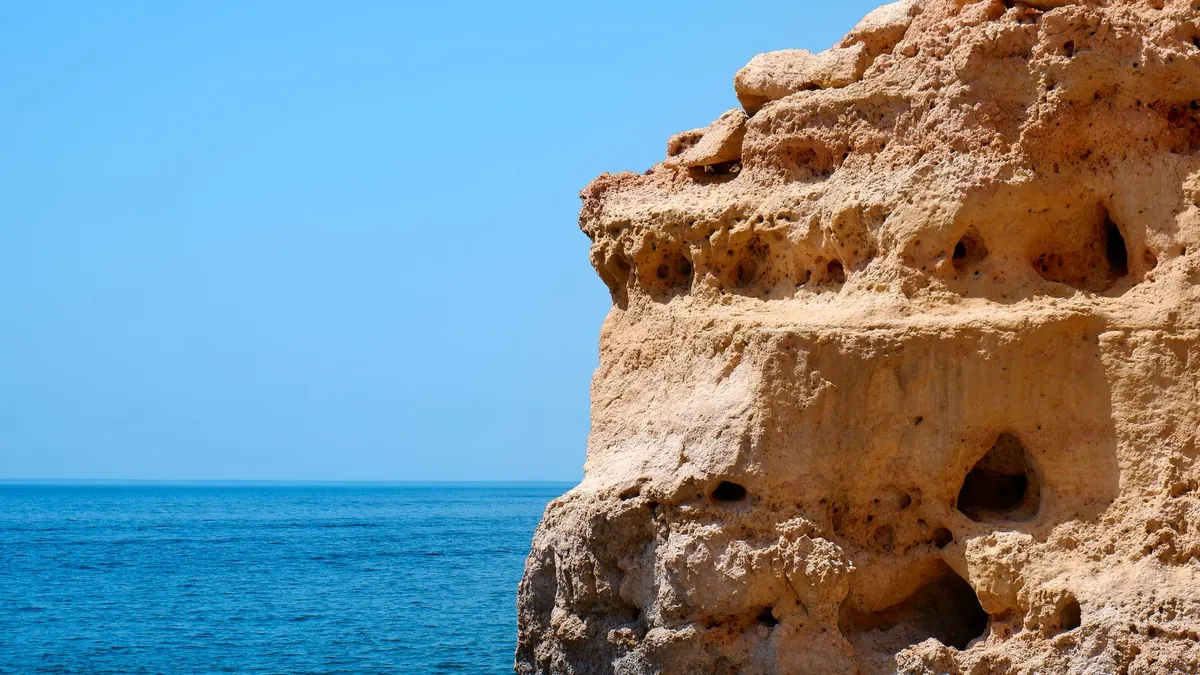
The result is a wave-cut notch: a hollow carved at the base of the cliff, roughly at the height where waves spend most of their energy. Once that notch is deep enough, the unsupported rock above it has nothing left to stand on. It shears off along a joint, and the whole face steps back. Repeat that for a few thousand years and the fallen blocks are ground into pebbles, the notch becomes a wave-cut platform, and a cliff that once stood further out is now a shelf for rockpooling at low tide.
Storms matter less than the sum of ordinary days. One winter gale can take a metre in a night, but it is the long, unremarkable months of moderate swell that keep the notch opening. Erosion is not a single event; it is a habit.
While the sea nibbles at the base, the atmosphere goes to work on the face. Rock is only strong in bulk. Break it into blocks, wet it and dry it, freeze it and thaw it, and it comes apart in layers.
Water gets into every crack and expands by about nine per cent when it turns to ice. That expansion is strong enough to lever stone apart. On a coast that thaws by day and freezes by night — a common pattern on shaded, north-facing cliffs in a British winter — the cycle can repeat dozens of times in a single month. Small flakes and fragments gather on the ledge below, ready to be swept up by the next high tide.
Spray leaves salt in the pores of the rock. As the water evaporates, salt crystals grow and push everything around them aside. It is the same reason brickwork and windowsills near the sea crumble. Porous rocks such as sandstone and chalk suffer badly; granite barely notices.
Clays and shales swell when wet and shrink as they dry, and the constant change cracks them from within. Add roots prising joints open, burrowing animals, and the weight of walkers on the same path along the top edge, and the cliff is being dismantled from three directions at once.
Rock is not defeated by the sea alone. It is soaked by rain, split by frost, prised by roots, and finally handed to gravity by the loss of its footing.
Gravity does nothing on its own; it simply waits for something to stop holding. Once the base is undercut or the rock is fractured, a cliff fails in one of a few recognisable ways.
Water is the hidden accomplice in all three. Rain fills the pores and joints, adding weight and reducing friction between blocks. That is why a cliff often collapses after a wet winter rather than during the storm itself: the sea has already removed the support, and the rainfall has greased the surface.
Retreat rates vary enormously, from a few centimetres a century on a hard, sheltered coast to several metres a year on soft, exposed cliffs.
You do not need instruments to see erosion at work. Look for:
Together these tell you not only that a cliff is eroding, but roughly how fast, and where the next failure is most likely.
Coastal erosion is not only a geology lesson. Cliff retreat takes farmland, footpaths, car parks, houses and holiday parks with it. Because the process is slow and then sudden, it is easy to underreact and expensive to overreact. Hard defences — sea walls, rock armour, groynes — can protect one stretch of coast, but they often starve the next stretch of sediment and simply move the problem along. Softer approaches, such as beach replenishment, managed realignment and leaving room for the sea, are increasingly preferred.
The honest conclusion is that a cliff edge is a line in time, not a line on a map. Whatever stands on it is only borrowing the ground.
Photo: Nils Rotura / Pexels